The cost of fragmentation
Missed obligations. Disconnected money decisions. Avoidable costs.
Fragmentation costs more than time spent looking for a document. It makes it harder to stay compliant, plan for commitments and judge whether family capital is being used well. The cost builds in everyday decisions—long before a crisis exposes it.
Obligations without oversight
Tax filings, residency requirements, policy renewals and recurring commitments sit in different calendars and inboxes. Without one view of what is due, missing or assigned, silent expiries become avoidable surprises.
What it can costA missed filing, a lapse in cover, a last-minute cash requirement—or an advisor assuming someone else is handling it.
Money managed in fragments
Cash, investments, debt and expenses are reviewed separately. A healthy account balance can hide an upcoming liquidity need; an isolated portfolio view can miss concentration or a more suitable ownership structure.
What it can costIdle cash alongside borrowing costs, poorly timed funding decisions, and income or tax-structure opportunities left unexplored.
Key-person dependency
The reason behind a financial decision, the next compliance step and the advisor who owns it live in the principal's head or one assistant's inbox. When either is unavailable, the family loses both context and continuity.
What it can costA staff departure or incapacity leaves obligations unowned and financial decisions waiting for someone who is no longer available.
Unevidenced succession
Wills exist, but no one can say which members are covered, which assets sit outside the plan, or what the next generation will actually inherit.
What it can costProbate, disputes between heirs, and wealth that does not transfer as intended.
Intelligent Automation
Intelligent automation that stays ahead of obligations.
So family capital works harder.
Intelligent automation is more than capturing information. It continuously watches which compliance obligations need attention, who is responsible, and where the family's money could work more efficiently — then connects those findings to your family's records, financial position and priorities.
Rule-based automation tracks recorded deadlines and surfaces gaps around the clock, while AI-supported portfolio analysis helps you and your advisors explore allocation, liquidity, income and tax-structure opportunities. Less time piecing together the picture; more time acting on what matters.
Your judgment. Your control.
- Your goals guide the analysis. Explore AI suggestions in the context of your objectives, risk preferences and recorded holdings. Your family and qualified advisors decide what to act on.
- Rules monitor. AI supports decisions. Alerts and obligation checks are rule-based. AI proposes options for review; it does not execute trades, payments, filings or renewals.
- Insight, not a guarantee. AI can make mistakes or lack information. Verify analysis with your advisors; suggestions do not guarantee returns, tax savings or compliance. AI access is limited to authorized roles.
Stay ahead of compliance
Intelligent automation surfaces what is due, what is missing and what needs follow-up across your family's jurisdictions.
- Use recorded residency and profile information to surface potential filing obligations.
- Track filing dates, policy renewals and document expiries, with rule-based alerts before recorded deadlines.
- Identify missing evidence and readiness gaps so your advisors know what needs attention.
Make money work smarter
Use AI-supported portfolio analysis to explore more efficient ways to allocate and structure family wealth.
- Review allocation, currency exposure and liquidity alongside projected income and outgoings.
- Explore AI-proposed allocation and restructuring options informed by your recorded portfolio and stated goals.
- Discuss income, liquidity and tax-structure opportunities with your advisors before making changes.
Turn obligations into action
A reminder is only useful if someone takes responsibility. Keep follow-through visible.
- Bring upcoming obligations and attention items into a shared view instead of scattered inboxes.
- Give work a clear owner and due date, with templates and approval steps to keep it consistent.
- Track progress and supporting evidence so the family can see what is resolved and what still needs attention.
Easier capture supports better intelligence.
Document extraction and voice or typed notes help keep the underlying records current. Review the proposed details before saving—then use that information to track obligations and inform financial decisions.
Explore document captureThe information existed,
but it was not governed.
Why Tracking Matters
One family decision.
Connected responsibilities.
Follow a family property from purchase to the next generation. Its value, owners, protection, obligations and future cannot be understood in isolation.An illustrative journey through connected records. Your family and advisors record, review and maintain the information.
A home is also a financial responsibility.
A family buys a property. Recording its value is only the start: the mortgage, rental income and running costs also matter. Without the financial context, an asset list cannot show what the family really owns and owes.
How it connects
Property value
combined with debt and cash flow
Family balance sheet
Who owns it—and who looks after it?
The property may belong to a family member, a company or a trust. Record that ownership alongside the people and advisors involved, so responsibility remains clear when a family member or a trusted manager is unavailable.
How it connects
Member or entity
owns the asset; a named person
Manages the responsibility
Ownership needs protection—and proof.
Keep the property's insurance, contracts and supporting documents in context. A policy without the covered asset is hard to assess; a decision without its evidence is hard to defend. Apply the same discipline to vehicles, with their own insurance, registration and renewal records. Intelligent document capture extracts these details for your review, reducing the friction of keeping records current.
How it connects
Asset
protected by coverage and supported by
Policies, contracts & evidence
A change in family life changes what needs attention.
A move abroad can change tax-filing obligations. Travel makes passport and visa dates important. Property maintenance and renewals need owners and due dates. Keeping personal records, family plans and operational responsibilities current helps the right person act before a deadline is missed.
How it connects
Residency, expiry or renewal
informs an obligation with
An owner & a due date
The next generation needs more than an asset list.
Review how the property fits into estate plans and beneficiary arrangements. Recorded plans and evidence make gaps visible in readiness reviews; the dashboard brings the wider picture into view. Role-based access lets the family and its advisors participate without sharing everything with everyone.
How it connects
Ownership, plans & evidence
inform readiness and help prepare
An orderly handover
One governed system of record
Four outcomes. One connected system.
FamVault is not a collection of features. It is a governance system built to deliver four specific results for a multi-generational family — everything else is in service of them.
Know everything
A live, multi-currency picture of the whole balance sheet and the whole family—connected in one system.
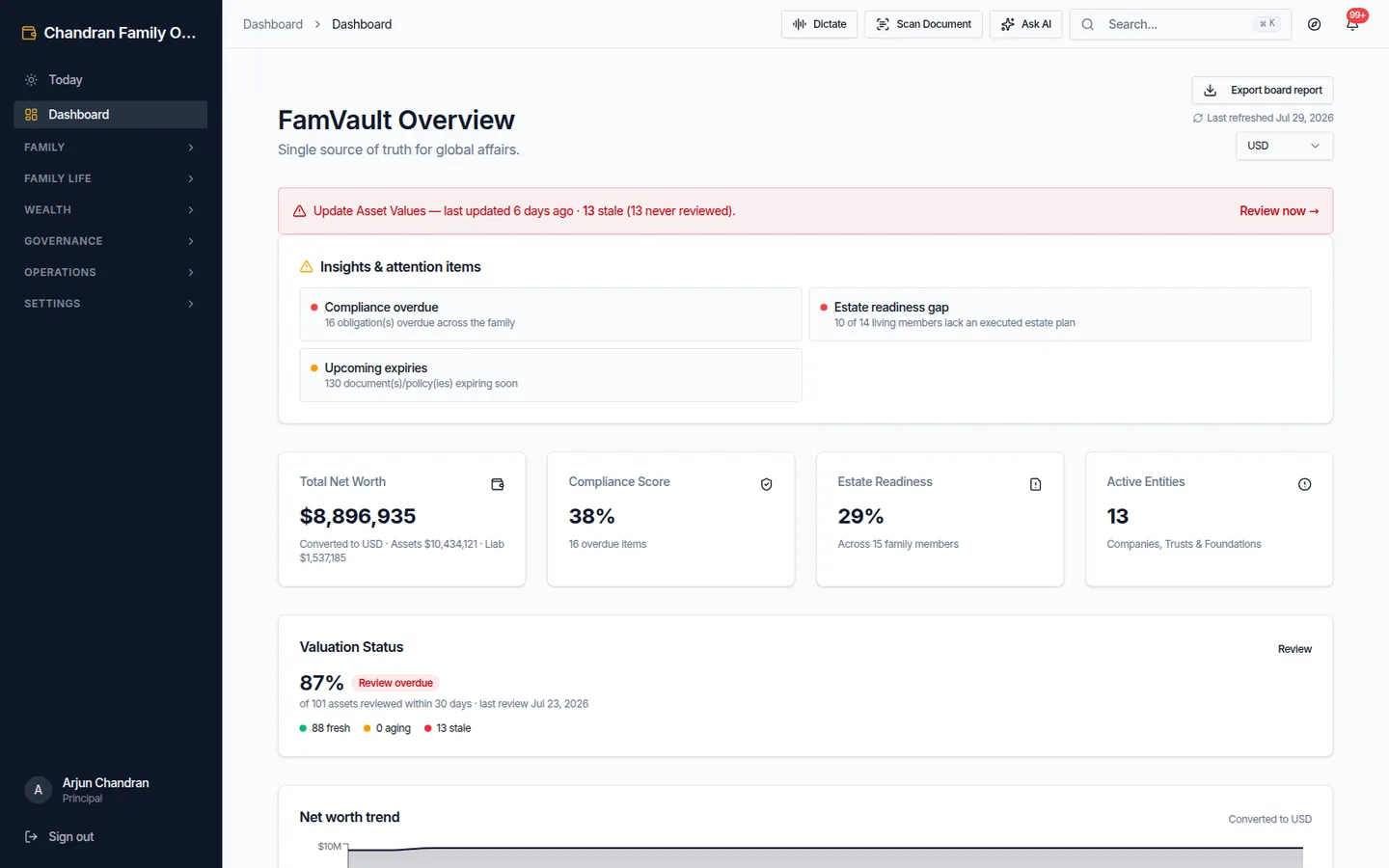
- Net-worth dashboardA live, multi-currency view with valuation reviews
- Family directory & treeProfiles across generations
- Finances, real estate & vehiclesComplete asset records
- Document vaultCategorized, OCR-assisted, and org-isolated
Miss nothing
Bring recorded expiries, renewals and deadlines across jurisdictions into view, with clear ownership before they become incidents.
- Compliance & tax obligationsFiling calendars and who-files-where rules
- Alerts & approvalsClear owners, due dates, and escalation paths
- Insurance gapsVisibility into uninsured and underinsured assets
- Incident & event logA complete factual record when needed
Protect the succession
Estate readiness treated as a measurable state, so the family always knows who is covered and who is exposed.
- Estate plans & beneficiariesPer-member readiness tracking
- Readiness frameworkScored across pillars with a gap register
- Entities & trustsStakeholders, share classes, and board governance
- Family councilFormal meetings, resolutions, and action items
Control who sees what
Confidentiality by architecture. Access is scoped to the role and enforced by the platform.
- Scoped rolesStrict least privilege for family and advisors
- Two-factor authenticationTOTP or passkeys, with recovery codes
- Scoped data roomsTime-limited, audited external sharing
- Full audit trailAttributed and reviewable platform changes
Designed around every role
Access is earned, never assumed.
Specific roles cover everyone who manages the family's wealth and responsibilities. Each sees exactly what their role requires — and nothing more.
The Family
Principal
Full control of the family office — every record, every member, every setting.
Co-Principal
Shared day-to-day control of records and members alongside the principal.
Trustee
Focused access to estate plans, beneficiaries, entities and stakeholders.
Family Member
Each member's own profile, records and personal documents.
Fiduciaries & Advisors
Advisor
Read-only visibility into the full picture for wealth managers and consultants.
Accountant
The financial picture — accounts, investments, liabilities and valuations.
Tax Preparer
Tax records, filing calendars and the documents needed each season.
Legal Counsel
Legal documents, contracts, disputes and estate paperwork.
Operations
Office Manager
Day-to-day operations — tasks, workflows, staff and service providers.
Property Manager
Real estate, vehicles, utilities and everything that keeps them running.
Compliance Officer
Compliance items, renewals, filings and the full audit trail.
Staff
A streamlined task and workflow view for the people who manage daily operations.
External Parties
Guest
Time-limited, audited data-room access for external parties — nothing more.
Security first
Protection worthy of your most private records.
FamVault holds the most sensitive picture a family has. It is built for confidentiality from the ground up — and every protection is enforced by the platform, not promised by policy.
2FA & passkeys
App-enforced two-factor authentication with TOTP, passkeys and recovery codes.
Encrypted & isolated
Secrets encrypted at rest and every client's data fully isolated from every other.
Complete audit trail
Every change is recorded, attributed and reviewable — nothing happens off the record.
You are trusting us with everything.
FamVault is not self-serve software. Every family's workspace is scoped, configured, and onboarded deliberately.
Request access
Tell us about your family's structure — members, jurisdictions, entities, and who manages the wealth today. Every request is reviewed personally.
Private consultation
A confidential walkthrough of the platform against your situation, where we show what gets consolidated first, and how your advisors participate.
Your vault, configured
We stand up your family's private, isolated workspace, configure roles and jurisdictions, and support the first onboarding of records and documents.